Centre National Intégré du Manufacturier Intelligent


Projects



Centre National Intégré du Manufacturier Intelligent
The New CNIMI Building Welcomes the Future
In 2019, Université du Québec à Trois-Rivières (UQTR) began construction of a new pavilion on its Drummondville campus: the National Integrated Centre for Intelligent Manufacturing (CNIMI). Connected to the adjacent pavilion by an underground tunnel and built on a fully wooded site, the CNIMI was inaugurated in 2022. Today, it welcomes students from two institutions—the Cégep de Drummondville and UQTR—and supports manufacturing companies seeking to undergo digital transformation and integrate new technologies, such as industrial robotics, directly into their production processes.
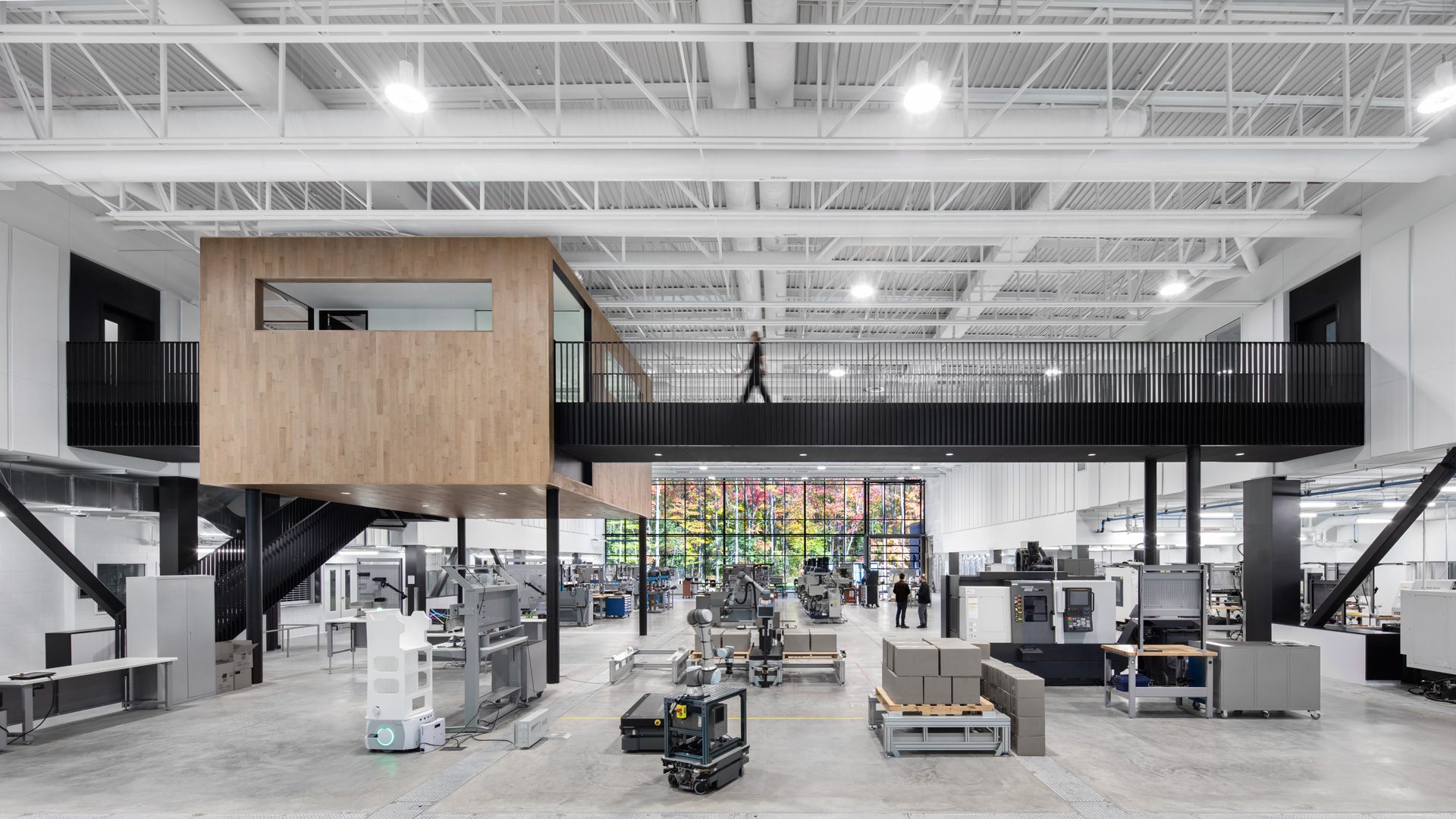
The centerpiece of the CNIMI is a large factory-laboratory equipped with metal machining and welding equipment, as well as industrial robots, where training, university research, and technological demonstrations coexist. All areas of the building overlook this vast, light-filled space located at the heart of the pavilion, clearly expressing the core mission of the centre. The CNIMI also includes classrooms and teaching laboratories, creativity hubs for collaborative research with industry, an administrative sector, and a public area housing a cafeteria and a multipurpose room designed to host special events.
The final concept, both simple and thoughtful, skillfully merges the centre’s innovative and technological vision with its wooded surroundings—a true architectural achievement expressed throughout the building. Every component of the CNIMI was carefully designed to highlight its natural setting and to create a bright, inspiring interior atmosphere that fosters the development of new ideas.
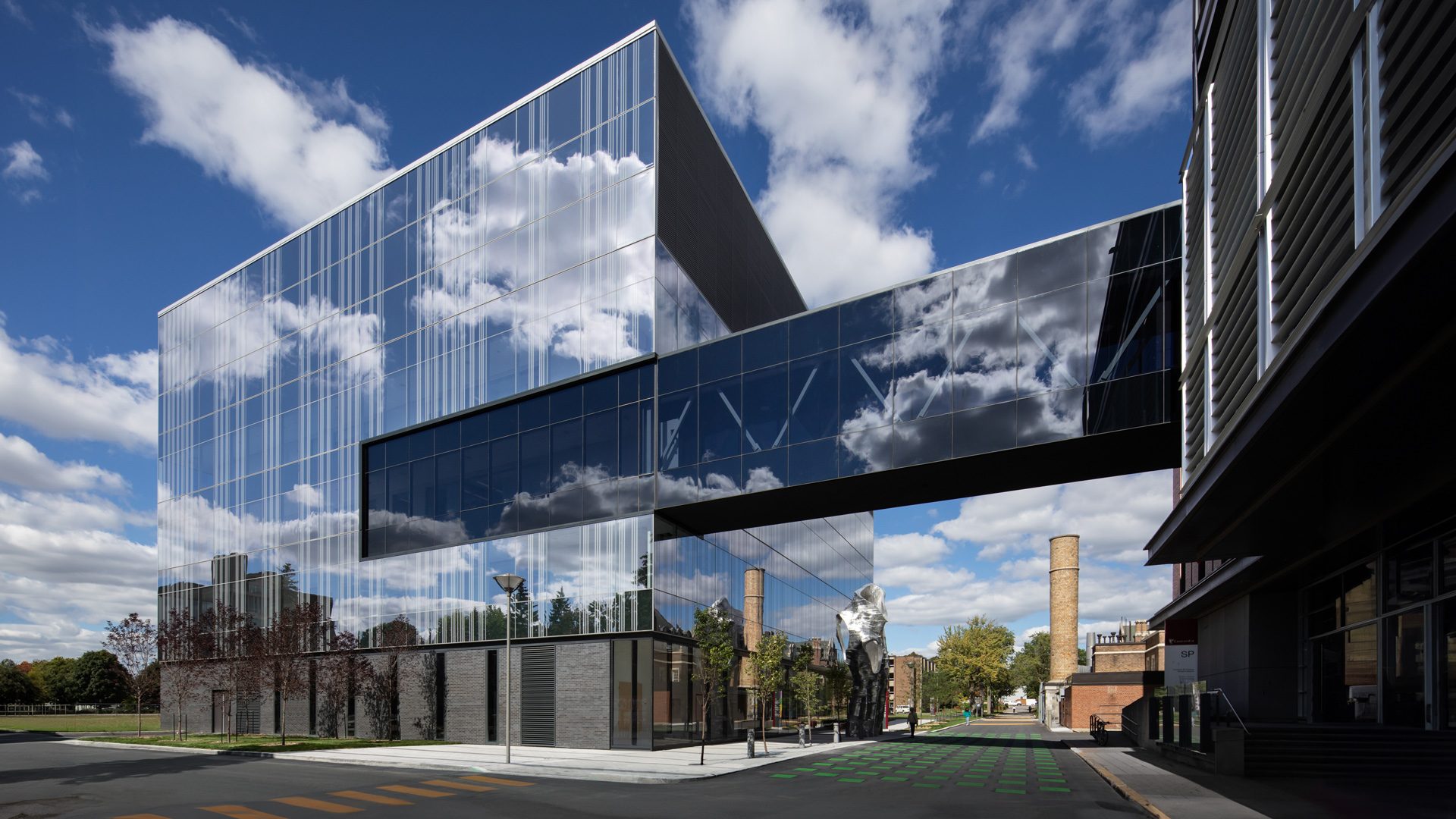
A large transparent opening runs through the building from one façade to the other, allowing natural light to penetrate deep into the pavilion, where the public spaces and the double-height factory-laboratory are located. The CNIMI’s side façades are clad in mirror-polished aluminum panels that reflect the surrounding trees, visually reinforcing the density of the forest. At both ends of the central space, expansive glazed façades open onto the woodland, making the forest an integral part of the interior experience.
At the center of the building stands the factory-laboratory, flanked by classrooms on one side and offices on the other. This configuration creates distinct spatial zones while ensuring acoustic insulation for classrooms and offices from industrial equipment noise, all while maintaining visual transparency. The space offers great flexibility thanks to a trench system integrated into the concrete floor slab, allowing for the distribution of electrical and data cabling as well as compressed air lines.
To bring the outdoors inside and add warmth, wood elements were incorporated throughout the building, including the entrance vestibule arch and the suspended volumes within the double-height space that house technician areas and creativity hubs. Inside, white predominates on all surfaces, with the exception of the windows and curtain walls, which are black to avoid creating excessive contrast with the surrounding forest.
6 000 m²
Grands Prix du Design 2023 | Grand Winner – Interior Design
Grands Prix du Design 2023 | Platinum Winner – Interior Design: Education, Institution & Healthcare / University & Higher Education
Grands Prix du Design 2023 | Platinum Winner – Interior Design: Special Awards / Interior Design +Wood
Grands Prix du Design 2023 | Gold Certification – Architecture: Public Building / Higher Education & Research Building
Grands Prix du Design 2023 | Silver Certification– Architecture: Special Award / Architecture + Landscape